Posts

Moths

Image
 Friday July 25 Pam got up soon after dawn  a few days ago, on her way to bringing on the moth traps. She looked out of her bedroom window to find a Tawny Owl looking back at her. It was sitting about ten metres away, swaying gently, on the telegraph wire which runs across the garden. That has been a month's highlight for her. My garden highlight was a yaffling Green Woodpecker. We often get the young feeding on ants in the lawn at this time of year. There have been some good moths around. We didn't see Giles' first for Norfolk Rest Harrow, unfortunately, but did see the Bedstraw Hawkmoth trapped by Roger Brownsword, and brought to NS by Mike H. An in the pot photo    Some of the moths trapped in our garden  Oak Eggar - big and beautiful    Yellow-legged Clearwing Two Micro moths Choreutis nemorana - Fig Leaf Skeletoniser Wingspan 16-20mm. This species is widespread in the Mediterranean and North Africa. The first for Britain was in 2014 when it...

Where to Go?

Image
 Wednesday July 16 After all the years of watching millions of Wood Pigeon, many when they nested in our birch tree, I had a new experience when sitting in the car ready for the off. Two fully grown Wood Pgeons were sat close together on top of the porch roof,  indulging in what we thought was courting behaviour. Longer inspection found it to be an adult feeding a very well grown, insatiable young, on the regurgitated 'pigeon milk'.  Much needed rain was falling as we drove to North Walsham, it did so for most of the morning, in the form of occasional, well spread, showers. Even after calling in at Sculthorpe Mill and Abbey Farm, the bird species seen did not enter double figures. As always, it was good to be out looking. As we drove out to Holme on a very good track (thank goodness), the sun came out. The number of butterflies increased, mostly Large White, the birds didn't. I don't think we have ever driven out to Holme without seeing Magpies before today. The gatekee...

In the Rain

Image
 Wednesday July 2 After a long dry spell, rain at last. When we set out it was a light drizzle, this continued all morning - apart from when it became  a gusty, windblown soak at Snettisham. The only birds that didn't seem to mind were the Wood Pigeons, they were on the road and tree tops when everything else was taking shelter. Gradually we started to make additions to the day list. Where we first park to scope the Wash, there is a large clump of a grass species. Pam pointed out that it held something else. The stems were covered in Ladybirds. This coincided with one of the heaviest showers. When it cleared enough for me to open a window, many of them had been washed/blown away - the light was poor too.   There had been a high-ish  tide, 5.7 metres, the water's edge was still visible. The birds on the mud really were not, especially the large flock of Black-tailed Godwit, apart from a white rump or wing stripe flash when they preened. Every bird we could see was pre...

There and Back

Image
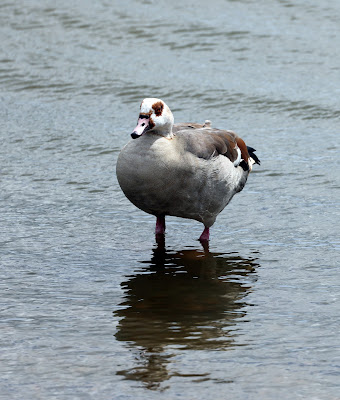
Sunday June 29 Pam as still not feeling herself after a couple of days stomach upset - she thinks it was the prawn lunch she had. Saturday was so very hot, the temperature reached the lower 30sC, that the prospect of an air conditioned car tipped the scales. We didn't set off until 10 a.m. and were home by 3 p.m. It was a much more reasonable temperature too, the sun hardly appeared. With only two short stops, at Sculthorpe Mill and Abbey Farm, we were soon at Snettisham. The first thing we noticed was the number of Egyptian Geese around, all with well grown young, they've had a very productive year here.   Scanning the vast expanse of puddled and creeked mud, I came across a stretch of what appeared to be roosting gulls. I worked my way throught them, finding that most of them were adult Mediterranean Gulls, Pam reckoned there were more than a hundred, the most I've ever seen together. Every bird was either asleep or busy preening.   I then noticed a few Sandwich Terns dot...

The June Doldrums

Image
 Thursday June 19 June is always considered to be a quiet month for birds,so far, this one is no exception, even worse if possible. In common with many other birders, mothing takes first place, especially using pheromone lures in the garden. The lures can be used for various micro moths, our targets are macro moths of the family Clearwing.  So far this year we have trapped five different species, three of which I've been able to photograph.  White-barred Clearwing Was a new species for us, spreading slowly from the Broads area, a nationally NB species.   Currant Clearwing New for the  garden, previously seen at Wiveton Fruit Farm.   Lunar Hornet Clearwing Trapped in the garden every year so far.    The unphotographed species are:  Yellow-legged Clearwing and Red-tipped Clearwing.

One Week Later

Image
 Sunday June 1 I believe that we'd have seen almost as many birds if we'd stayed at home and watched the garden. Although relatively warm, with sun most of the day, a strong wind is not conducive to birds. They stay hidden and don't sing as much - if at all. List ready, pen posed, I'd added two birds by the time we got to North Walsham, Carrion Crow and Wood Pigeon. It's sad that, for the first time since we have lived here, 1974, there are no Swifts around the White House. No Swallows in the village and no House Martins on our house, John's next door and the Hughes's across the road. The three weeks of no rain also meant no mud for nests. Did this deter them? We did see one Swift, and both the mentioned hirundine, during the day, but very few. We checked Strumpshaw Mill for Spotted Flycatchers, unsuccessfully. We don't know of anyone who has seen them this year, they do move their nesting sites around, some more viewable than others.  I've read that...

Last Day

 Friday May 23 As martin had offered to help pack the car, Pam spent the morning packing cases, organising the kitchen, packing foodstuffs etc. One moth in last night's trap, another new one for here, a Grey Dagger.  Burghead is not far, and a good place to sit and watch for passing seabirds.The birding area is dominated by the oldest Maltings in Scotland. It was here that we saw a first for Britain in November 1990. After school on Friiday, we drove to a Travelodge in Edinburgh, then on to Burghead on the Saturday. My coat had been forgotten, ( a fishtail parka, the trendy birding coat at the time), so we stopped in Aviemore without success. Early afternoon on an overcast November day when it looked like dusk, we set off in front of the Maltings. One birder was walking towards us and uttered the comforting words 'it's still there'. We found the Grey-tailed Tattler quickly, feeding amongst the rocks on the shore. Relief and jubilation - and we were the only people there...